
http://roadcrewreview.blogspot.com/2011/02/what-camo-is-best.html
http://roadcrewreview.blogspot.com/2011/02/what-camo-is-best-part-2-patterns.html
As we said in previous posts, your first load out should be standard woodland M81, as this is used on almost every airsoft field, and is acceptable at most MilSims as well. (A note on MilSims here; most milsims have fairly strict camo and load-out requirements as most military forces field with the same uniform. This adds to the military simulation feel of the event.) Your second load-out probably should be tan DCU (Tri color desert) or "chocolate chip" bdu's for the same reason. Both of these patterns are usually available surplus or at goodwill stores, so you can get into these load-outs for a fairly low investment.
But what if you want to stand out from the pack at your local skirmish fields?
Well, that's fairly easy! There is a world of camo beyond those patterns we covered in our second post, and this article will cover a few more of those.
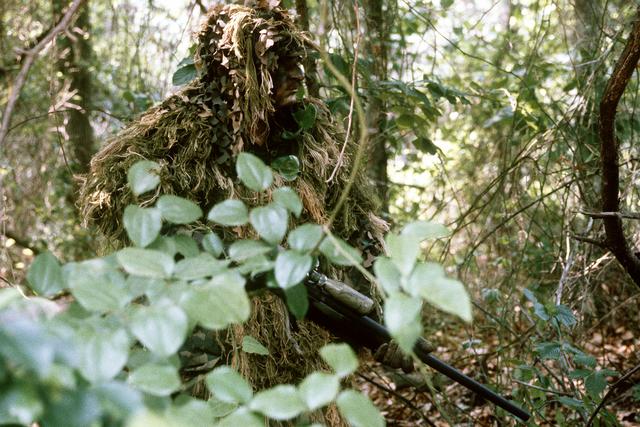
Camo started as a means for hunters to get closer to their prey, and one of the classic hunters outfits that has been adapted to military use is the ghillie suit. This is a camo base layer with loose grass and brush from the local area added to help blend effectively with the background. Ghillie suits are generally used in modern combat by snipers, and each is unique and hand made by the sniper that will wear it. Since they are unique, and the methods to make one are fairly extensive, we will have to come back and cover this in more detail in a later post. For now, if you want more info on these suits, either hit the link below or jump to your favorite search engine and see what you can find.
http://en.wikipedia.org/wiki/Ghillie_suit
While the ghillie suit is extremely effective camouflage, it can be hot and hard to move in, so early on various militaries developed disruptive patterns to camouflage their troops in the field. Patterns from the second world war are still in use today in some parts of the world, and are the basis of many modern camo patterns.
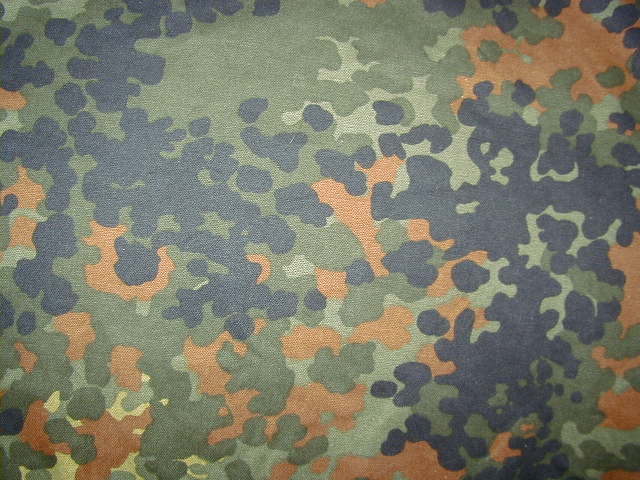
The German Flecktarn (spotted) camo is the basis for many camouflages in the modern era, and works to some extent like modern digital camo. At a distance the smaller spots blend together and form larger blocks of color with soft edges that blend well with backgrounds in the same color palette. Flecktarn can occasionally be found at surplus stores and can be easily found at online retailers. Again, as with many camo patterns there are different patterns for woodland areas and deserts, as well as snow camo. It is reasonably to very effective and works for an OpFor load-out well.

The British developed a camo pattern similar to Multicam, called MTP (multi terrain pattern). This pattern is relatively new, so it can be hard to find at surplus stores, but this pattern has been proven to be as effective as multicam with a slightly different look based more on tiger stripe (see below). As with multicam, it can be hard to determine if the wearer is on the green or tan team. We mention it here for those who might be interested in a variant on multicam.

Tigerstripe is a family of camouflage that was used primarily in close up jungle situations. Most camo is designed for longer range use, with larger patterns that may not be as effective within 50 feet (this is why flecktarn and modern digital camos have patterns that are designed for both close up and far viewing). The US ABU is a variant of tigerstripe and can occasionally be found in surplus stores. While never officially issued to US forces, many special forces units in Vietnam used the locally produced tigerstripe camo uniforms based on the French patterns. It is more effective close up (at airsoft ranges) than woodland, though may not be allowed at some MilSims.
In our next installment we will look at some civilian commercial camo designed for hunters, and discuss their use in airsoft.

No comments:
Post a Comment